> For the complete documentation index, see [llms.txt](https://docs.ezalgo.ai/llms.txt). Markdown versions of documentation pages are available by appending `.md` to page URLs; this page is available as [Markdown](https://docs.ezalgo.ai/user-guides/installation-and-setup/getting-started.md).
# Getting Started
## Things to Note
Details to note about EzAlgo V13 and EzOscillator V6.1:
The indicators are not showing up
We add users to the script within (24) hours of purchase. Keep in mind if you have not yet provided us your TradingView username in [#algo-access](https://discord.com/channels/985565017938219018/1068627427586220174) channel, please do so.
Study Not Auth* Error
If you run into the error "**Study Not Auth\***" when trying to set up the algo, simply refresh your page and it should fix the issue. This happens often at first use.
Heiken Ashi Candles
We recommend to use Heiken Ashi Candles within TradingView. EzAlgo is built around them and functions best with them, but Japanese work fine as well.
## Getting to know EzAlgo V13
Our mission with EzAlgo is to simplify trading via combining price action and algorithms. In V13 we’ve included artificial intelligence using the KNN (k-nearest neighbors algorithm) model.
The learning curve with EzAlgo is fairly easy and you should have a full, in-depth understanding of the algo within a few minutes.
There are **(2)** main indicators within EzAlgo, explained in the following pages.
## Making EzAlgo Your Own
EzAlgo is separated into (2) separate trading indicators - EzAlgo V13 and EzOscillator V6.1.
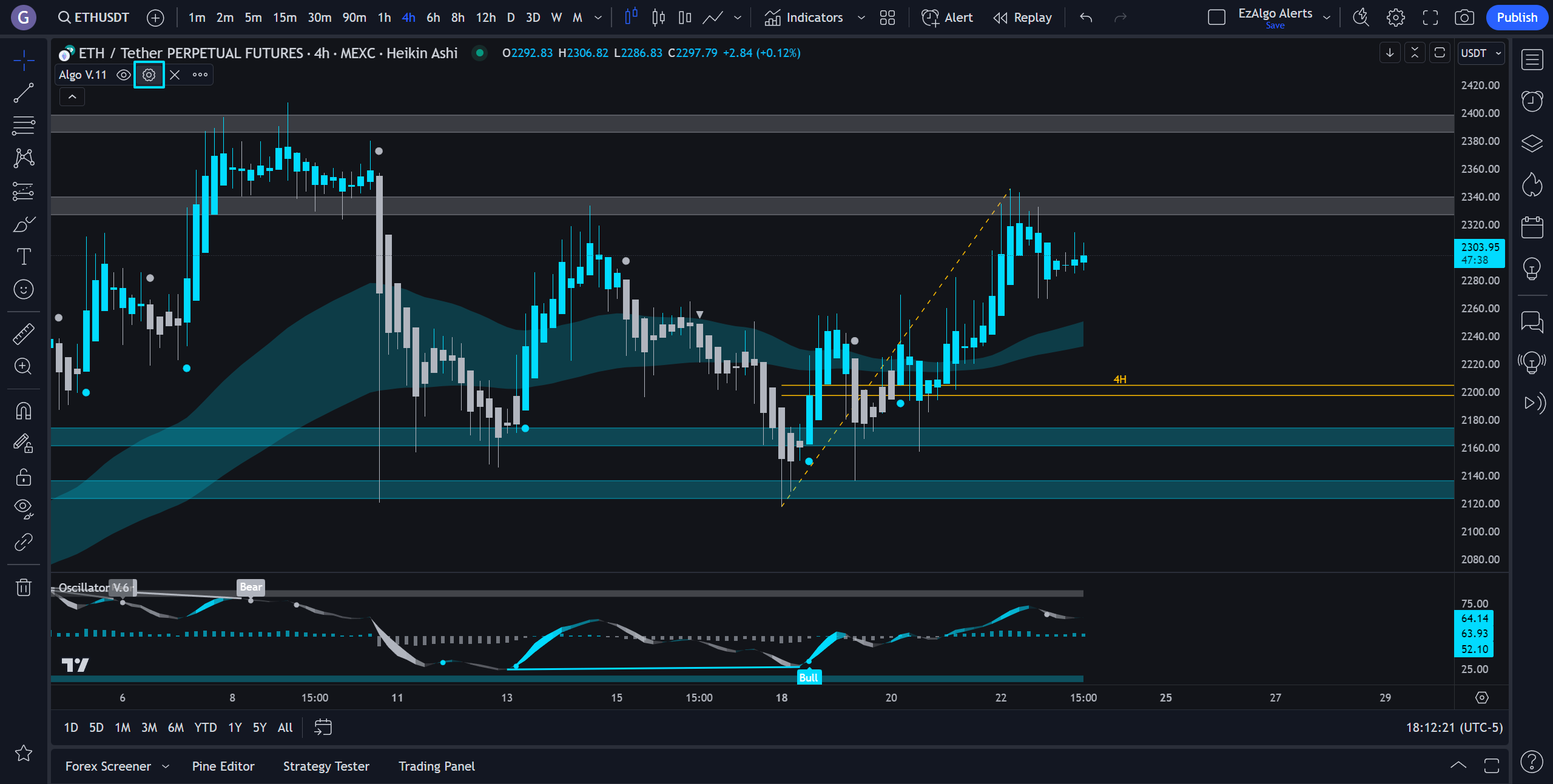
To start, we'll cover EzAlgo V13 first. To change settings, hover your mouse over the EzAlgo indicator at the top left of the screen right under the asset name you are trading, and click the settings icon.
Here you will have the ability to customize your settings for each input depending on your trading style.